How Equity Funds Work
A clear examination of asset pooling, net asset value calculation, fund manager mandates, and unit issuance processes.
Read MoreDiscover fundamental equity fund research, understand strategic portfolio allocation, and establish informed long-term wealth planning methodologies designed for clarity.
Targeted capital allocation across market sectors.
Harnessing compound market cycles over time.
Strategic diversification to moderate volatility.
Objective analysis of holdings and benchmarks.
A four-stage analytical journey to evaluate fund structures, risk parameters, and mandate clarity before organizing portfolio holdings.
Identify whether the scheme targets capital appreciation, regular income, or thematic market opportunities over specified time horizons.
Evaluate the core strategy: bottom-up stock selection, top-down macroeconomic positioning, growth-oriented, or value-driven equity selection.
Analyze standard deviation, beta relative to benchmark indices, sector concentration thresholds, and historical drawdown behavior.
Examine asset breakdown by market capitalization, top 10 company exposures, active cash buffers, and overall sector distribution.
Gain a thorough understanding of different fund structures, market capitalization focuses, and strategic sector mandates.

Invests in top-tier established market leaders with solid balance sheets, proven business models, and steady historical resilience.
Explore Details
Targets medium-sized enterprises experiencing operational expansion, combining scalable market potential with moderate risk.
Explore Details
Focuses on emerging companies with early-stage business models, offering high structural expansion potential alongside higher volatility.
Explore Details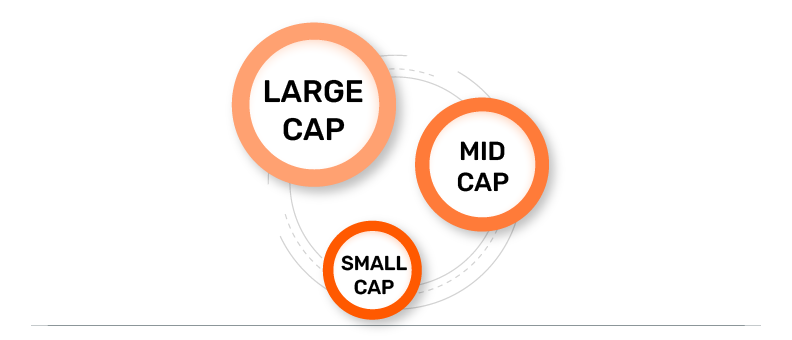
Maintains mandated allocations across large, mid, and small-sized companies, ensuring structural diversification across cycles.
Explore Details
Dynamic asset allocation strategies that shift capital fluidly across market capitalization tiers according to changing market valuations.
Explore Details
Specialized equity portfolios dedicated to specific economic verticals such as technology, infrastructure, healthcare, or energy.
Explore DetailsComprehensive analytical perspectives designed to guide objective evaluation without speculative projections.
Carefully examining the Scheme Information Document to confirm alignment between fund investment mandates and individual financial timelines.
Assessing performance behavior across multiple market cycles, rolling return distributions, and tracking error consistency relative to benchmarks.
Tracking concentration levels in top holdings, cash reserve variations, and sector overweighting trends to gauge portfolio balance.
Contrasting Growth-oriented equities prioritizing revenue acceleration against Value strategies seeking intrinsic valuation discounts.
Reviewing drawdown depth, standard deviation, downside capture ratios, and liquidity factors to understand true risk exposure.
Developing disciplined holding habits, managing reinvestment cycles, and avoiding reactive trading during cyclical market corrections.

A robust equity fund functions as a structured ecosystem of diversified assets. Analyzing how weight is distributed across market dimensions is crucial for informed investment planning.
Distribution between large stable caps and dynamic medium or small enterprises.
Diversification across banking, technology, energy, healthcare, and industrials.
Limiting single-company concentration risk through broad equity distribution.
Maintaining strategic fidelity between growth, value, or blend philosophies.
Cultivating an objective mindset is the cornerstone of sustainable, long-term wealth organization.
Focus on multi-year compounding cycles rather than daily price fluctuations.
Acknowledge inherent equity volatility and align it with personal risk tolerance.
Conduct periodic rebalancing without making impulsive changes to allocations.
Spread capital across complementary categories to reduce single-sector vulnerability.
Base portfolio adjustments on documented strategy rather than market sentiment.
In-depth editorial analysis exploring structural mechanisms, portfolio construction, and risk metrics.

A clear examination of asset pooling, net asset value calculation, fund manager mandates, and unit issuance processes.
Read More
How regulatory classifications differentiate large cap, mid cap, hybrid, and thematic funds according to allocation constraints.
Read More
Exploring mathematical covariance, unsystematic risk reduction, and why simply owning more funds is not true diversification.
Read More
How to verify whether a scheme's portfolio holdings faithfully match the objectives outlined in its investment mandate.
Read More
A breakdown of standard deviation, beta coefficients, drawdown recovery cycles, and how volatility differs from permanent loss.
Read More
Constructing a multi-decade asset allocation strategy tailored to lifecycle milestones, liquidity needs, and risk tolerance.
Read MoreFour foundational pillars designed to guide disciplined capital organization across changing market conditions.
Systematically accumulating equity exposure across disciplined market cycles to establish long-term capital foundations.
Spreading exposure across market cap tiers, complementary sectors, and investment styles to reduce asset concentration.
Incorporating defensive assets, emergency reserves, and volatility awareness to protect capital during downturns.
Conducting structured annual evaluations and rebalancing to ensure allocations stay aligned with evolving targets.
Click items below to track key due-diligence milestones before finalizing portfolio allocations.
Essential insights to clarify equity structures, diversification principles, and long-term research methodologies.
An equity fund is a pooled investment vehicle that primarily allocates capital into shares of publicly traded companies. Managed by professional fund managers according to a defined mandate, equity funds enable individual investors to access diversified stock portfolios across various industries and market capitalizations.
Equity funds are predominantly categorized by market capitalization (Large Cap, Mid Cap, Small Cap, Multi Cap, Flexi Cap), investment style (Growth, Value, Blend), and thematic/sector focus (Technology, Healthcare, Energy, Banking). Each category carries distinct volatility and growth profiles.
Diversification reduces company-specific and sector-specific unsystematic risk. By allocating across multiple companies and industries, adverse events impacting a single business are buffered by the stability of the remaining portfolio holdings.
In equity investing, risk refers to the degree of price volatility and the potential for temporary or permanent capital drawdowns resulting from market corrections, economic downturns, or company-specific operational headwinds.
Over extended periods, equity markets historically reflect economic productivity and corporate earnings growth. A long-term perspective allows investors to ride out short-term market cycles, benefit from compounding, and avoid emotional decision-making.
Investors review a fund's objective by studying its official Scheme Information Document (SID), Key Information Memorandum (KIM), and monthly factsheets, which outline asset allocation ranges, benchmark indices, risk gradings, and management strategy.
Explore fund categories, read comprehensive investment research, and establish structured wealth strategies built for long-term clarity.